

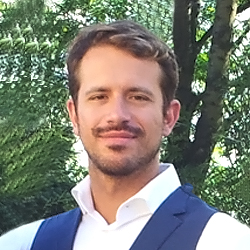
João Vieira

During my undergraduate degree I developed a taste for the areas of communication and digital signal processing. It was that interest, combined with a personal willingness to get to know new cultures and new (...)

João Vieira - Undergraduate degree in EN in 2011 - 2012

1. What has been your career path after completing the course?

During my undergraduate degree I developed a taste for the areas of communication and digital signal processing. It was that interest, combined with a personal willingness to get to know new cultures and new ways of thinking, that led me to look for international master programmes which focused on those areas. I enrolled for a Masters in Wireless Communications at the University of Lund in Sweden. Lund is known as the birth place of Bluetooth technology which integrates many of our smartphones today. It was also at that university that I later finished my doctorate, where I researched communication systems whose base stations use hundreds or even millions of aerials simultaneously to communicate with mobile devices (i.e. mobile phones). I currently work at Ericsson's research department where I carryout research for 5G systems which will come into use in 2020.

2. Which aspects of your academic training were relevant to your profession?

Many of the subjects in the undergraduate degree of Electronics and Telecommunications Engineering at the University of Madeira approach fundamental aspects which help to understand how today's telecommunications systems work. The foundations from subjects such as Signals and Systems, Communication Systems and Electromagnetism were crucial in my academic path following my undergraduate degree. All the hours spent on studying for those subjects were well invested. The degree also contributed towards my maturity as an engineer and a professional. I also developed other aspects such as critical thinking, work methodology and oral and written communication skills throughout the degree. Another aspect, though not of technical nature, which was crucial in my journey after my undergraduate degree was the taste developed for the subjects - in a great deal thanks to some of my former teachers. It was this which motivated me to follow a career in the area. It was also many of these teachers who were ready to help when I wanted to go abroad and who I still remain in contact with today.

3. Who would you recommend your course to?

In my point of view a degree should not be seen as a goal, it should be seen as an opportunity to acquire specific knowledge and mature in a professional sense (and as a means to a better quality of life). Seeing that many professional outcomes in the area of Electronics and Telecommunications Engineering are constantly being updated, knowledge needs to be reiterated which implies having interest and motivation. Therefore, I recommend the course to all those who have a genuine interest in understanding how a lot of today's technology works, who enjoy mathematics and its applications, to those who enjoy challenges and that are intrinsically motivated.

4. Why the University of Madeira?

As islanders, the University of Madeira is a very convenient option to study. Taking into consideration my journey so far, I can say that the quality of education and availability of staff members is notorious. The University of Madeira frequently collaborates with international universities, which may oopen doors for those who dream beyond. The environment at the university is also extremely friendly and offers many opportunities on a social level. I know many former students who struggled with social integration at secondary school yet felt completely at home at the University of Madeira.